Abusive relationships don’t exist in a vacuum—they thrive where systemic oppression, cultural erasure, and disability marginalization intersect. For Indigenous disabled survivors, the risk of abuse is compounded by generational trauma—the psychological wounds passed down through colonization, forced assimilation, and institutional violence.
This article explores:
– How historical trauma fuels present-day abuse cycles.
– The unique barriers faced by Indigenous disabled survivors.
– Culturally grounded solutions breaking these cycles.
—
1. Generational Trauma: The Roots of Vulnerability
Historical Oppression: Normalized Abuse
Indigenous communities worldwide have endured:
– Residential/Boarding Schools – Children forcibly removed, abused, and stripped of cultural identity (Truth and Reconciliation Commission of Canada, 2015).
– Forced Sterilization – Disabled Indigenous women targeted in the U.S. and Canada until the 1970s (Stote, 2015).
– Medical Exploitation – Disabled Indigenous people institutionalized under eugenics laws (Dowbiggin, 2003).
Impact Today:
– Distrust of social services (fear of child removal, institutionalization).
– Normalization of violence as a survival tactic.
– Higher rates of substance use, mental health struggles (Brave Heart, 1998).
—
2. The Intersection: Indigenous & Disabled Survivors

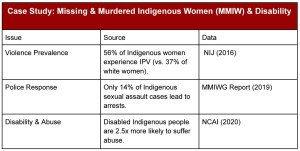
Case Study: The Missing and Murdered Indigenous Women (MMIW) Crisis
– Disabled Indigenous women are disproportionately targeted for violence (Deer, 2015).
– Police often dismiss reports, especially if the victim has a cognitive disability (Amnesty International, 2009).
—
3. Solutions Rooted in Sovereignty & Disability Justice
A. Indigenous-Led Programs
1. StrongHearts Native Helpline (U.S.)
– Culturally specific domestic violence support.
– Citation: [strongheartshelpline.org]
2. Ma Mawi Wi Chi Itata Centre (Canada)
– Provides wraparound services for Indigenous survivors, including disability advocacy.
– Citation: [mamawi.com]
B. Disability-Inclusive Advocacy
– Native American Disability Law Center – Helps navigate legal barriers.
– Survivor-led peer networks – Like the Indigenous Survivors of Abuse Network (ISAN).
C. Policy Changes Needed
– Tribal jurisdiction over abuse cases (currently limited by U.S. federal law).
– Funding for reservation-based respite care for disabled survivors.
—
The Path Forward
To truly support Indigenous disabled survivors, we must:
1. Acknowledge generational trauma as a root cause.
2. Fund Indigenous-led solutions—not impose Western models.
3. Integrate disability justice into tribal advocacy.
We are not just surviving—we are reclaiming.
—
References
– Brave Heart, M. Y. (1998). The return to the sacred path: Healing historical trauma.
– Deer, S. (2015). The beginning and end of rape: Confronting sexual violence in Native America.
– Truth and Reconciliation Commission of Canada. (2015). Final Report.
 We Are Not Broken
Leave a comment